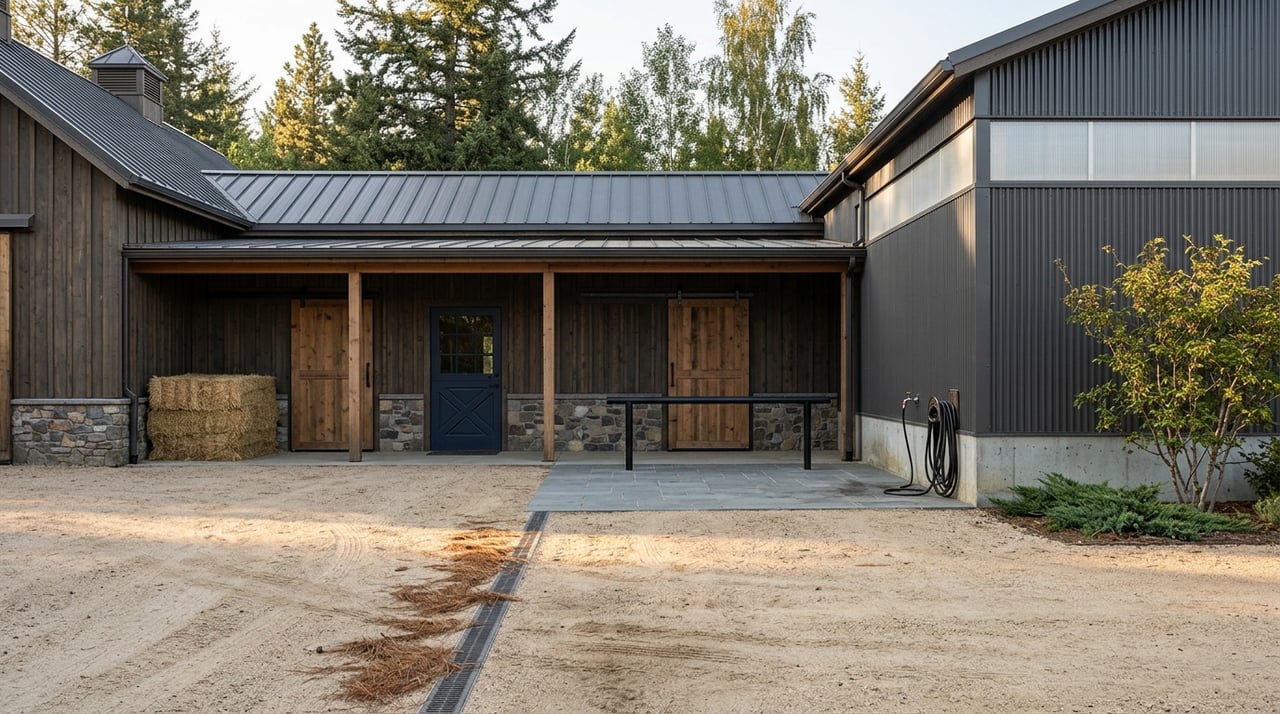
Choosing An Equestrian Property In The Whitefish Area
June 11, 2026
June 11, 2026
If you are searching for an equestrian property near Whitefish, a pretty barn and a few open acres are not enough. In this part of Northwest Montana, the right property needs to work legally, function well in every season, and support the way you actually live with horses. When you know what to check before you buy, you can avoid costly surprises and focus on a property that truly fits your goals. Let’s dive in.
One of the most important first steps is confirming whether a property is inside the City of Whitefish or in Flathead County. That line matters because the city and county follow different land use rules for livestock. A parcel that looks horse friendly at a glance may have very different limits depending on where it sits.
Inside Whitefish city limits, livestock is only allowed in certain zones and is subject to density standards. The city code allows horses at two per acre, with horse-and-foal density at three per acre, and it requires enough usable pastureland to support the number of livestock units on the property. The code also says livestock will not be permitted where usable pastureland is less than one-half acre.
In residential zones within the city, barns and stables must be placed in rear or side yards and set back at least 50 feet from property lines. If you want more animals than the standard density table allows, the city may review that request through a conditional use permit process. That review can consider nearby land use, property management, runoff, waste disposal, noise, and odor.
In Flathead County, horse properties are often easier to find, but zoning still matters. In AG Agricultural districts, the county places no restriction on animal units. In SAG-10, SAG-5, Suburban Agricultural, Rural Residential, and R-1 or R-2.5 districts, livestock is allowed on tracts of at least one acre, with a density cap of one animal unit per acre, and a horse counts as 0.50 animal unit, or two horses per acre.
Some county zones also limit use. In R-2.5 and R-1 districts, livestock is allowed only for domestic use or consumption and not for commercial purposes. The county also requires livestock in certain residential zones to be kept inside fenced enclosures, and like the city, it will not permit livestock where usable pastureland is less than one-half acre.
A property can feel rural and still have limits that affect how you use it. That is why acreage alone does not tell the full story. If you plan to keep a few personal horses, your needs may be very different from someone considering a larger setup.
This is especially important if you are thinking about boarding, lessons, or a more intensive horse operation. In the Whitefish area, those uses may require a different zoning district or additional review. Before you fall in love with the view, it is worth confirming exactly what the zoning allows.
The biggest mistake many buyers make is assuming total acreage equals horse-ready acreage. In reality, the land that matters most is the land your horses can actually use. Both Whitefish and Flathead County tie livestock standards to usable pasture, not just the overall parcel size.
Flathead County defines pastureland as land inside a completely fenced area that is available to the livestock. The county also notes that if there is less than one acre of usable pasture, supplemental feed is required. That makes the quality and layout of the ground just as important as the lot size listed on paper.
When you walk a property, look closely at how much of the land is flat, drainable, and practical for turnout. Steep slopes, wooded sections, wet ground, and awkward corners can quickly reduce what is truly usable. In a mountain market like Whitefish, that difference can be significant.
As you evaluate a property, ask practical questions like these:
These questions often tell you more than the total acre count ever will.
Mud control is a serious issue in the Whitefish area. Local trail systems offer a useful reminder of how quickly wet ground can deteriorate. Whitefish Legacy notes that the Whitefish Trail is vulnerable during muddy periods and asks users to avoid soft conditions because horses and bikes can create ruts and erosion. Herron Park also warns about muddy and slick footing in wet weather.
That same pattern shows up on private property. Gates, dry lots, paddock entrances, laneways, and areas around water tend to wear down first. Once hoof traffic compacts the soil, water infiltration drops and mud can build fast.
Extension guidance recommends placing buildings, feeding areas, storage, and shelters on higher ground. It also notes that an ideal drainage slope is about four to six degrees. High-traffic pads can also make a major difference in places that see repeated use.
A good equestrian property is not just about shelter. It is about how the entire site works together day to day. In Whitefish, that means your turnout areas, feed access, driveway, manure plan, and winter circulation all deserve careful attention.
If a property has an arena, look at footing retention and perimeter design. Montana State University Extension advises using kick boards or similar edging around arena edges to help keep footing in place. It is a small detail, but one that can affect long-term function and maintenance.
The Whitefish area has a winter-forward climate, and your property should reflect that reality. NOAA normals from the nearby Kalispell Glacier Airport station report 16.76 inches of annual precipitation and 54.4 inches of annual snowfall. December averages 15.9 inches of snowfall, and January averages 13.9 inches, with January mean temperatures well below freezing.
That means horse property features that feel optional in milder climates become essential here. Water access, shelter placement, snow management, and barn design all need to support daily horse care through winter. Summer riding may be beautiful, but winter functionality is what often determines whether a property is truly practical.
Montana State University Extension recommends focusing on four basics in winter horse care:
The same guidance notes that horses do best when they can stay dry and out of the wind. A lean-to, shed, or windbreak can help during adverse weather. It also notes that drinking water should ideally stay between 45 and 60 degrees, which means heated water systems or consistent ice removal can be important on a Whitefish-area property.
When buyers picture a horse barn in Montana, they often focus first on warmth. Warmth matters, but air movement matters too. A barn that traps moisture and stale air can create ongoing issues.
University of Minnesota Extension states that horse barns need air exchange to remove moisture, reduce condensation, and improve air quality by limiting dust and ammonia. The same guidance explains that naturally ventilated barns are generally less costly, while mechanically ventilated barns are designed for year-round conditions and allow more airflow control.
Insulated walls and ceilings can also help barns stay warmer in winter and reduce moisture buildup. If you are comparing properties, barn design should be part of the conversation, not just stall count or exterior appearance.
For many horse owners, riding access is part of the lifestyle they want in Whitefish. The Whitefish Trail is a major local amenity, described by Whitefish Legacy as a non-motorized, year-round trail system with a loop of more than 55 miles around Whitefish Lake. Its rules also state that bikers yield to hikers and both must yield to horseback riders.
Beyond town, the Flathead National Forest offers additional public riding opportunities. The forest states that horse riders have the right of way on multiple-use trails. It also identifies Whitefish Divide Trail #26 as a 37-mile non-motorized trail open to horse riding and Hay Creek Trail #3 as a 5.4-mile trail open to non-motorized use.
Public land riding comes with its own rules, including forage requirements. The Flathead National Forest notes that weed-seed-free forage is required on Forest Service lands in Region One and on public lands in Montana. If trail access is part of your plan, it helps to understand both proximity and day-to-day hauling logistics.
Even a beautiful property can feel isolated if everyday support is too far away. In the greater Flathead Valley, equine services are part of the bigger property equation. That includes veterinary care, boarding options, trailer parking access, and public riding infrastructure.
Herron Park in Kalispell describes itself as the Flathead Valley’s only public horse park. It offers horse access, trailer parking, seasonal water, manure disposal bins, and horse-specific trail and event programming. For many buyers, that kind of amenity adds flexibility and community access beyond their own land.
LaSalle Equine Clinic in Kalispell lists large animal and equine services, including lameness care and 24/7 emergency care. Ranch 'M in Kalispell advertises boarding amenities that include multiple pastures, loafing sheds, a heated feed room, a round pen, an outdoor riding arena, and heated water tanks. Even if you plan to keep horses at home, nearby support still matters.
In practical terms, the best equestrian properties near Whitefish tend to combine several key features. They align horse use with the correct zoning, offer meaningful usable pasture, and include infrastructure that supports winter care and wet-season drainage. They also make everyday access to riding, hauling, and equine services easier.
That is why a thoughtful property search matters so much in this market. The right equestrian property is not just scenic. It is workable, well-matched to your goals, and ready to support your horses through every season.
If you are considering an equestrian purchase in Whitefish or the greater Flathead Valley, having local guidance can make the process much more efficient. Kimberly Wilson offers tailored support for buyers seeking lifestyle properties with the right mix of land, access, and long-term practicality.
Stay informed with expert insights, market updates, and lifestyle inspiration from Whitefish and the surrounding Montana communities.
June 11, 2026
June 4, 2026
May 28, 2026
May 21, 2026
May 14, 2026
May 7, 2026
April 23, 2026
April 16, 2026
April 9, 2026
With decades of experience and a commitment to exceptional service, Kimberly is dedicated to helping clients achieve their real estate goals.
Kimberly Wilson
Address 204 CENTRAL AVE WHITEFISH, MT 59937